Your Biggest Competitor Probably Isn't Who You Think It Is
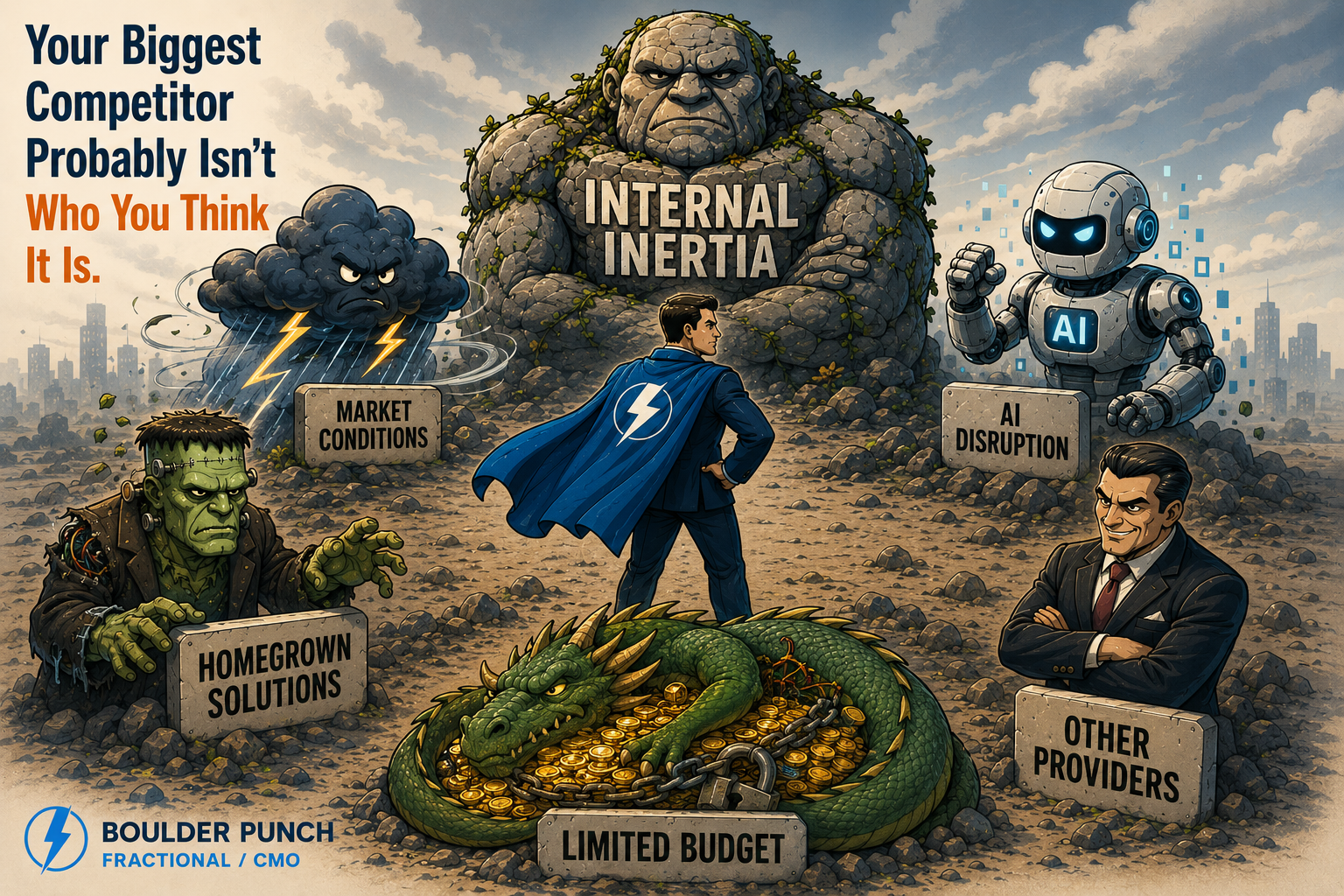
One of the first questions I ask clients when we begin discussing their market is surprisingly simple:
What do you consider your biggest competitor?
The answers are usually predictable. They'll mention the largest company in the industry, an aggressive new startup, or the competitor that seems to win the most deals. Those are all legitimate answers, but over the years I've become convinced they're often focusing on the wrong competitor.
More businesses lose opportunities to the status quo than they do to another vendor.
Projects get delayed. Budgets get pushed into next quarter. Leadership priorities shift. A key executive leaves the company. The business problem still exists, but the decision quietly moves to the bottom of the list. Months later, everyone agrees the issue still needs to be addressed, yet nothing has changed. It's easy to assume you lost to another company when your customer simply wasn't ready to change.
I once worked with a sixty-year-old industrial manufacturing company whose marketing department was filled with talented, hardworking people. Every day they were writing copy, designing brochures, creating sales collateral, supporting HR, updating presentations, preparing trade show materials, and responding to a constant stream of requests from other departments. They weren't underperforming. If anything, they had become exceptionally good at serving the internal organization.
The problem was that almost none of their time was being invested in creating future demand.
Over the years, marketing had gradually evolved into an in-house creative production department. Years had passed without a meaningful review of the company's positioning, demand generation strategy, customer research, or even a serious audit of which activities were contributing to growth. Trade shows continued because they'd always attended them. Campaigns continued because they'd always existed. Success was increasingly measured by how quickly Marketing could respond to internal requests rather than by its contribution to pipeline, brand awareness, or customer acquisition.
No one intentionally decided to stop investing in growth. It happened gradually, one request at a time, until urgent internal work displaced the strategic activities that create future demand. The marketing team stayed busy, but the business quietly became less visible in the marketplace.
That's how organizational inertia works. It rarely arrives with a dramatic announcement. Instead, it settles in slowly until familiar routines begin replacing thoughtful strategy and people stop questioning whether the way they've always done things is still the best way forward.
The same pattern shows up in buying decisions. I've watched sales teams invest weeks preparing proposals, conducting demonstrations, answering technical questions, and building strong relationships with prospective customers, only to hear, "We've decided not to move forward right now." Often, it isn't a rejection of the solution. It's a decision to postpone change because the perceived risk of acting still feels greater than the perceived cost of waiting.
That's why I believe one of marketing's most overlooked responsibilities is helping buyers answer a question many companies forget to ask:
Why now?
Most organizations spend tremendous energy explaining why they're better than the competition. They compare features, pricing, customer testimonials, and technical capabilities. Those things matter, but they don't address the biggest obstacle. Buyers also need to understand the cost of waiting. What opportunities are being missed? How much inefficiency has become accepted as normal? What revenue, productivity, or competitive advantage is quietly slipping away because the organization has become comfortable with the status quo?
This isn't about creating artificial urgency or relying on high-pressure sales tactics. Sophisticated buyers see through those approaches almost immediately. It's about helping people recognize that maintaining the status quo is also a business decision, and every business decision carries consequences. Sometimes the greatest risk isn't making the wrong choice. It's delaying a decision that everyone already knows needs to be made.
I've come to believe that every purchase is really a choice between two futures. One offers the promise of improvement, while the other offers the comfort of familiarity. Most marketing focuses almost exclusively on the future it can create, but the strongest companies also acknowledge the invisible force pulling customers in the opposite direction. They recognize that their real competition isn't always another company. More often, it's the natural human tendency to postpone change until circumstances force the issue.
Your biggest competitor isn't always another company. More often, it's the comfort of the status quo.