Expertise Has Never Been Easier to Buy. Leadership Has Never Been Harder to Find
One of the biggest changes I've witnessed over the past twenty years has nothing to do with AI, social media, or marketing automation. It's how marketing organizations are built.
Twenty years ago, most companies hired a marketing department. Today, they assemble a marketing ecosystem. There may be an in-house marketing manager, an outside agency, a paid media specialist, an SEO consultant, a PR firm, freelance designers and writers, a marketing automation platform, AI tools, sales enablement software, and customer data platforms. Add Sales, Product, and Customer Success to the mix, and suddenly dozens of people influence the customer experience.
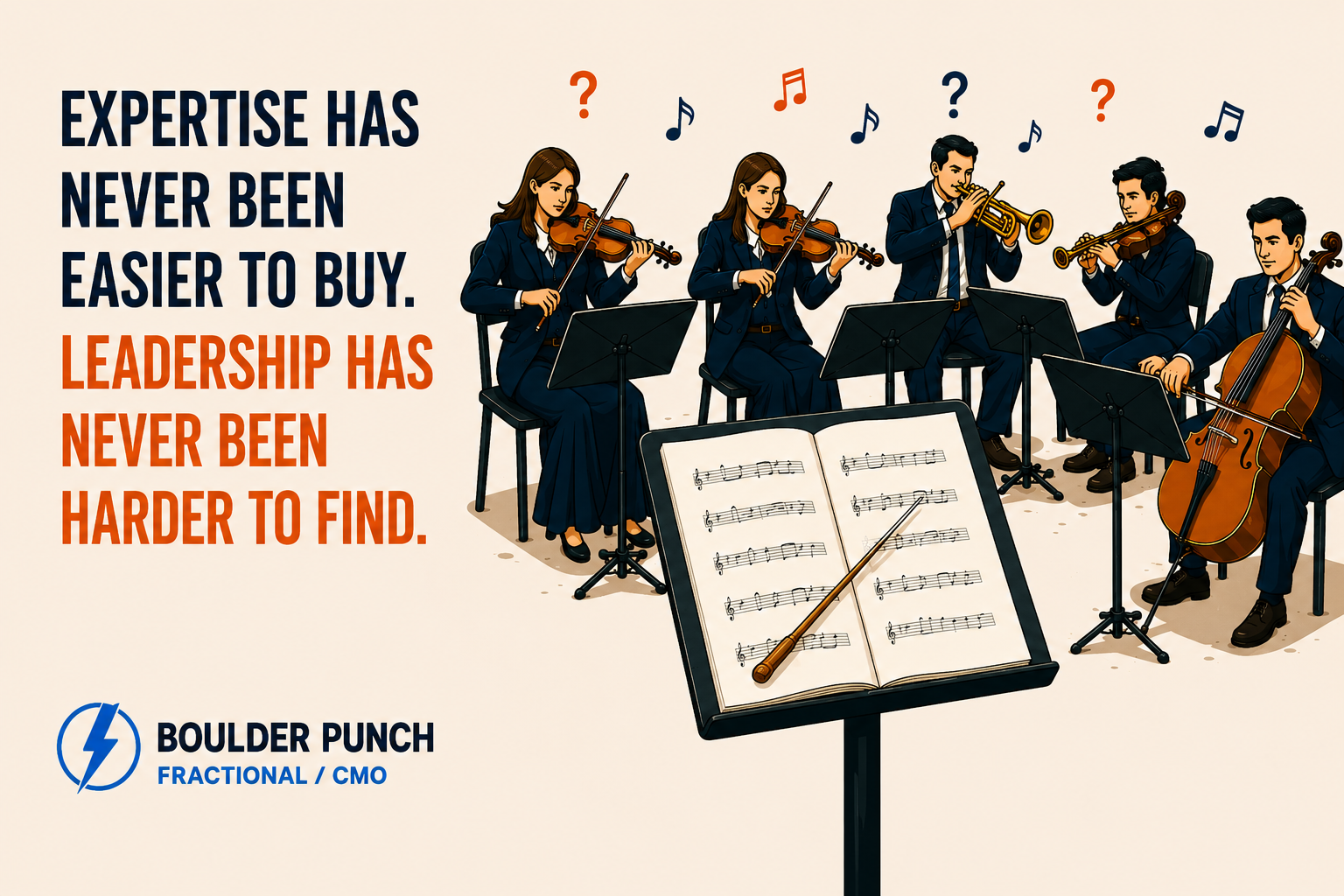
Individually, every decision makes sense. Collectively, however, it creates a new challenge. Expertise has never been easier to buy. Leadership has never been harder to find. I'd take that one step further: expertise is abundant. Alignment is scarce. In my experience, that's become one of the defining challenges for growth-stage companies.
Most organizations don't suffer from a lack of talented people. They struggle because those talented people are optimizing their own areas without a shared understanding of where the business is headed. Agencies optimize campaigns. Sales focuses on pipeline. Product builds features. Customer Success drives retention. Each team is doing exactly what it was hired to do, but those priorities don't naturally align themselves. Someone must connect the dots.
One of the most successful demand generation initiatives I ever led didn't begin with an advertising campaign or a new website. It started with customer research. We launched an industry survey to better understand the challenges our customers were facing and what was changing in the market. Those insights didn't stay inside the marketing department. They became the foundation for blogs, webinars, podcasts, white papers, PR, sales enablement, and product discussions.
What made the initiative successful wasn't the content itself. It was the way those insights flowed throughout the organization. Marketing learned something Sales didn't know. Product heard customer needs that hadn't yet reached the roadmap. Sales gained messaging that reflected how customers described their challenges instead of how we assumed they described them. As those insights moved across departments, they influenced campaigns, product priorities, sales conversations, and ultimately contributed to a 35% increase in SQLs and significantly stronger collaboration between Marketing, Sales, and Product.
That experience reinforced something I've observed throughout my career. The companies that consistently outperform their competitors don't necessarily have better agencies, larger marketing budgets, or more sophisticated technology. They simply do a better job creating alignment across the business. Marketing understands Sales. Sales influences Product. Customer Success shares what it's hearing from existing customers. Leadership establishes clear priorities, and everyone understands how their work contributes to the same growth strategy.
That's where leadership creates its greatest value. It's not about being the smartest marketer in the room. It's about ensuring the smartest people in the room are solving the right problems together. When that happens, specialists become dramatically more effective because they're no longer optimizing individual tactics. They're contributing to a shared strategy that moves the entire business forward.
Expertise is abundant. Alignment is scarce. Companies that solve that challenge create one of the few competitive advantages that can't be replicated by buying another piece of software, hiring another agency, or adding another specialist.