Five People. Five Different Stories
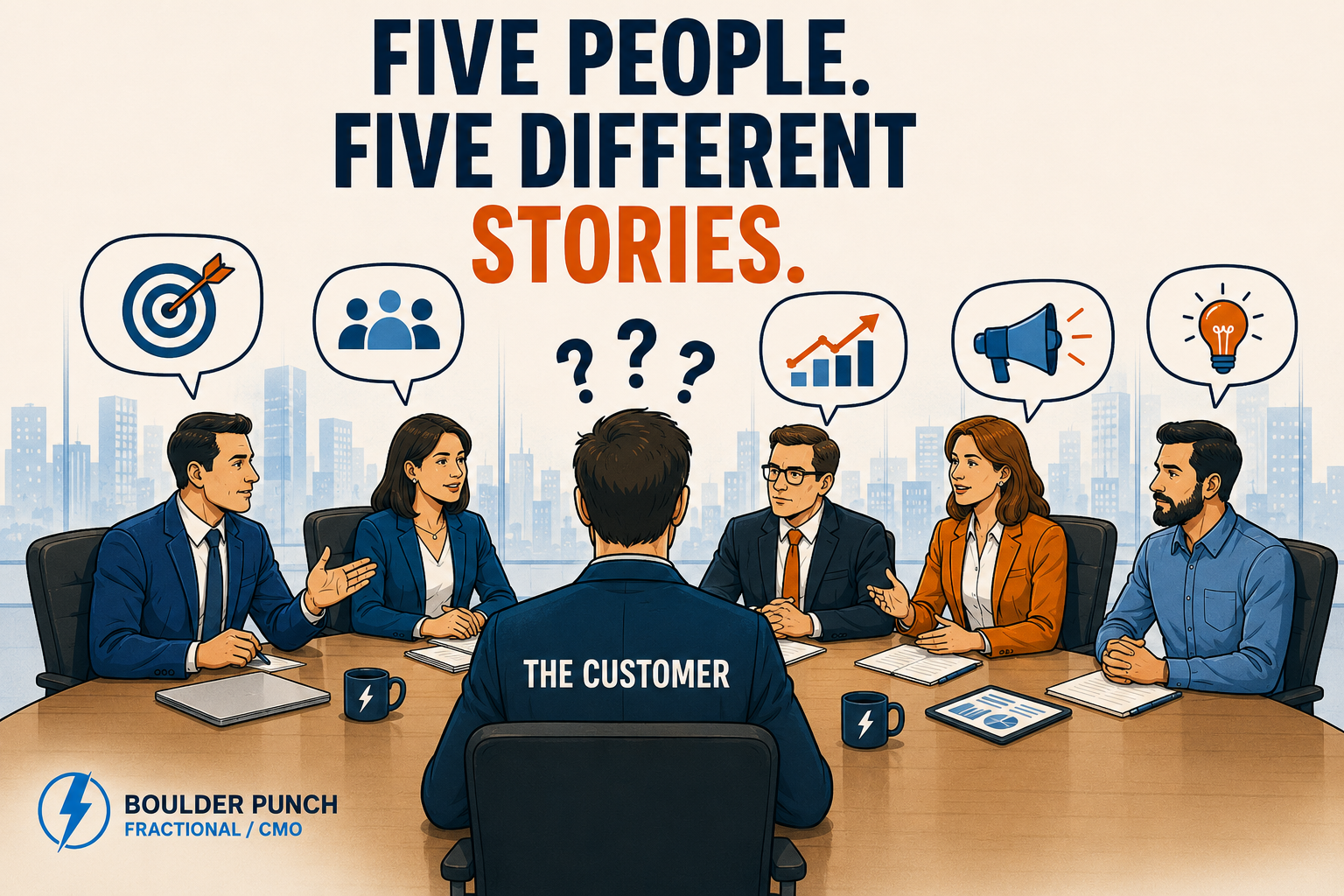
One of my favorite exercises when I begin working with a new client is deceptively simple. I'll gather five people from different parts of the organization and ask them the same question:
"What does your company do?"
Almost without exception, I get five different answers.
The interesting part is that every answer is usually good. The CEO talks about the company's vision and market opportunity. Sales focuses on customer pain points and business outcomes. Product explains capabilities and differentiators. Customer Success emphasizes relationships and long-term value. Marketing discusses positioning and brand. If I listened to each person individually, I'd probably think they worked for a great company.
Individually, none of these perspectives are wrong. They're thoughtful, relevant, and shaped by each person's daily responsibilities. The challenge is that customers don't experience companies one department at a time. They experience a single organization through a series of interactions. They visit your website, download content, attend webinars, speak with sales, participate in demonstrations, and eventually work with implementation or customer support. Every interaction contributes to their understanding of who you are, what you stand for, and why they should trust you.
When those experiences reinforce one another, confidence grows naturally. Buyers feel like they're engaging with an organization that understands itself, understands its customers, and has a clear point of view. When every interaction tells a slightly different story, however, buyers are left trying to connect the dots themselves. That's a difficult task for people who are already overwhelmed with information, competing priorities, and no shortage of vendors promising similar outcomes.
The challenge is that messaging drift rarely happens intentionally. It develops gradually as companies grow. Sales adapts language that resonates during customer conversations. Marketing refreshes website copy to support a new campaign. Product introduces terminology that better reflects evolving capabilities. Customer Success emphasizes responsiveness because retention has become a strategic priority. Every adjustment makes sense on its own, yet over time the organization can find itself speaking several different dialects without realizing it.
I've seen companies invest heavily in rebranding initiatives, website redesigns, new messaging frameworks, and demand generation campaigns, only to discover that their own employees still describe the business in fundamentally different ways. At that point, the issue isn't creative execution or lead generation. It's organizational alignment.
What's interesting is that this almost always surprises the CEO. When I first ask about messaging, branding, and the company's value proposition, the answer is usually some version of, "We're all on the same page." They genuinely believe the organization is aligned because the leadership team has discussed it, the website has been updated, or a branding exercise was completed a year or two earlier. It's only after I begin meeting individually with department heads and team members that the inconsistencies become apparent. The disconnect isn't intentional, and it usually isn't obvious from inside the organization because everyone assumes they're telling the same story. Looking at it through the eyes of a customer, however, the gaps become much easier to see.
Preventing messaging drift requires more than a well-written brand guide or a successful rebranding project. It requires an ongoing commitment to communication, coordination, and collaboration across the organization. Sales, Marketing, Product, Customer Success, and executive leadership all influence how customers experience the brand, which means they need regular opportunities to align on positioning, customer feedback, competitive changes, and market priorities. Someone must own that responsibility and create the discipline to keep those conversations going over time. Without clear ownership and consistent collaboration, even the strongest messaging will gradually fragment as the business evolves.
One of the responsibilities I value most as a marketing leader is helping organizations rediscover and maintain a common language. That doesn't mean scripting every conversation or asking everyone to memorize the same elevator pitch. In fact, I think that usually sounds forced. Sales should sound like Sales. Engineers should sound like engineers. Customer Success should sound like Customer Success. Each department should bring its own expertise and personality to the conversation while reinforcing the same core story and value proposition.
I've rarely found companies that lacked a compelling story. More often, they had too many versions of it. Helping an organization maintain a shared narrative isn't glamorous work, but it influences everything from marketing and sales to recruiting, product development, and customer retention. When departments communicate regularly, challenge each other's assumptions, and stay aligned around a common understanding of the customer, that consistency becomes visible in every interaction. Customers stop experiencing a collection of departments and begin experiencing a single, well-aligned company.