What Your Dashboard Can't Tell You
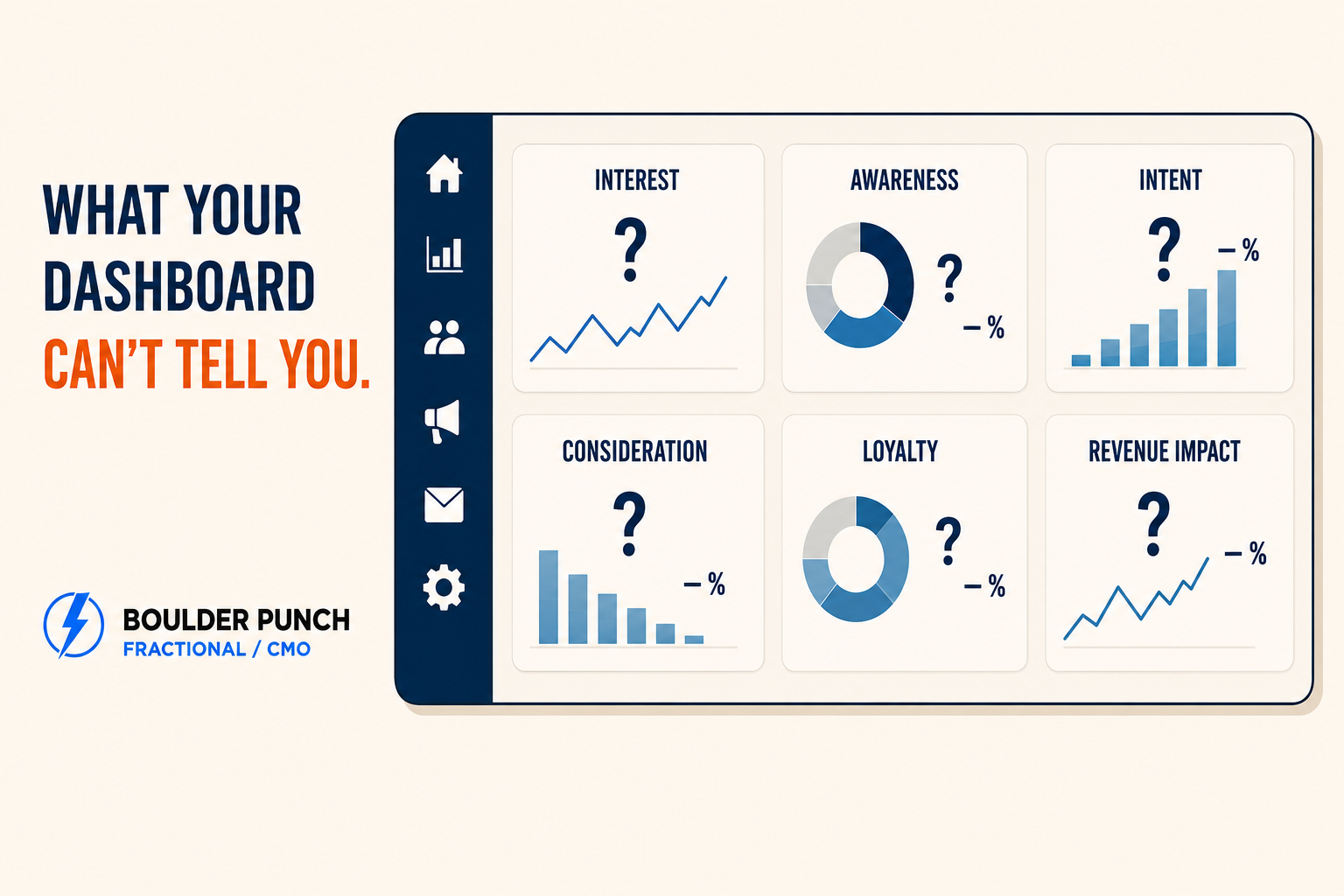
Marketing has never been easier to measure. Every campaign produces dashboards. Every email generates open rates and click-through rates. We can track website visitors, engagement, attribution models, conversion funnels, and pipeline reports with remarkable precision. Compared to twenty years ago, today's marketing leaders have access to an incredible amount of information, and that's unquestionably a good thing.
The challenge is that just because something can be measured doesn't necessarily mean it matters. I've watched organizations celebrate a 40 percent email open rate while Sales quietly points out that pipeline quality is declining. I've seen marketing teams optimize landing pages, webinars, and paid campaigns only to discover months later that revenue hasn't meaningfully changed. The dashboards looked healthy. The business didn't.
Somewhere along the way, we've become very good at measuring activity and surprisingly poor at measuring influence. An email open isn't interest. A webinar registration isn't buying intent. A website visit isn't demand. Even a marketing-qualified lead is simply the beginning of a conversation, not evidence that marketing has done its job. The metrics themselves aren't the problem. I rely on them every day because they help identify trends, validate assumptions, and improve execution. The mistake is believing they tell the whole story.
The most valuable marketing insights I've uncovered during my career rarely came from dashboards alone. They came from listening to sales calls, interviewing customers, reviewing lost opportunities, attending trade shows, and asking simple questions like, "Why did you choose us?" and, just as importantly, "Why didn't you?" Those conversations often reveal motivations, objections, competitive pressures, and buying behaviors that no analytics platform will ever capture.
That's one of the reasons I believe Sales, Marketing, Product, and Customer Success need to operate as one connected system rather than four separate departments. Marketing may understand what first captured a prospect's attention. Sales learns why they ultimately bought or walked away. Product uncovers recurring feature requests and unmet market needs. Customer Success understands what creates long-term value, retention, and expansion opportunities. Each team sees a different chapter of the same customer story, and leadership's job is to connect those chapters into a complete picture.
This is one of the reasons I place so much value on customer research, win-loss analysis, and ongoing conversations with both prospects and existing customers. At Bolt On Technology, we partnered with a leading industry publication on a nationwide survey called "What Keeps You Up at Night?" to better understand the challenges facing repair shop owners. Those insights became the foundation for blogs, webinars, white papers, podcasts, PR, and sales enablement content that reflected real customer concerns instead of our assumptions. They also strengthened collaboration between Marketing, Sales, Product, and Customer Success by influencing messaging, sales conversations, future product priorities, and customer engagement. The initiative ultimately contributed to a 35 percent increase in new business SQLs, but the biggest takeaway wasn't the metric. It was the realization that the best marketing strategies begin by listening to customers and ensuring those insights shape decisions across the business. That's when customer research stops being a marketing exercise and starts becoming a competitive advantage.
Data will always be an essential part of marketing. It tells us what happened and often points us toward where we should investigate next. But data rarely explains why customers behave the way they do, why deals stall, why competitors win, or why one message resonates while another falls flat. Those answers come from conversations, curiosity, and a willingness to look beyond the dashboard. Great marketing has always been as much about listening as it is about measuring.
The companies that consistently outperform their competitors aren't successful because they measure more metrics. They're successful because they combine quantitative data with qualitative insight. They understand that dashboards measure performance, but conversations reveal opportunity. The companies that listen better make better decisions, build better products, create better customer experiences, and ultimately grow faster. That's where great marketing begins.