AI Is Your GPS. But Do You Still Know How to Read a Map?
I use AI every day.
Like most executives, I've incorporated it into my daily workflow. It helps me organize ideas, summarize research, challenge assumptions, analyze information, and accelerate work that used to consume hours. It's one of the most valuable productivity tools I've ever used, and I have no interest in going backward. In fact, I don't understand the leaders who dismiss it or refuse to learn it. AI isn't going away, and the companies that learn to use it well will almost certainly outperform those that don't.
At the same time, I find myself asking a different question than most people seem to be asking.
If AI disappeared tomorrow, would we still know how to think our way through the problem?
It's the same question I ask myself when I'm driving.
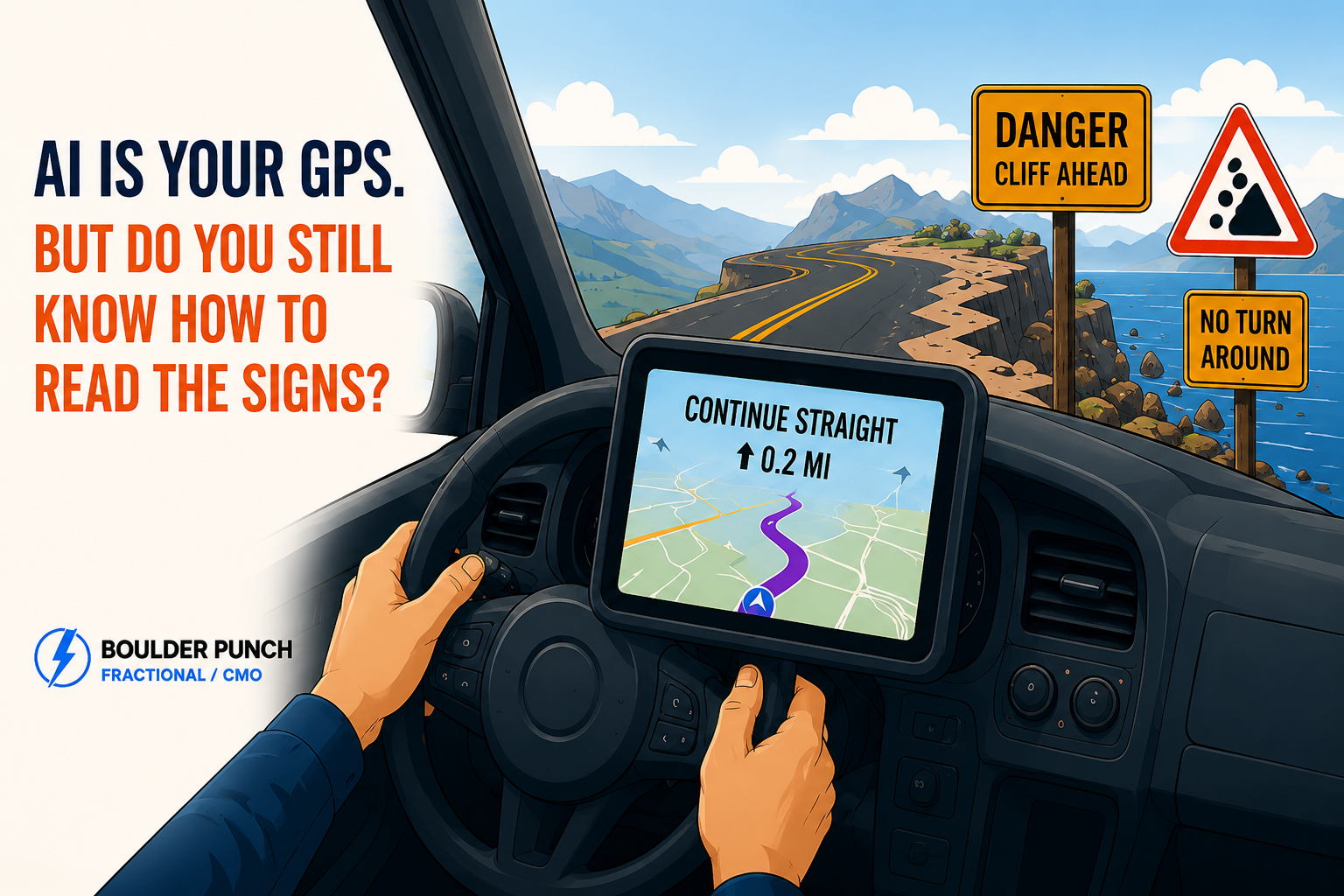
GPS gets me where I'm going faster. It reroutes me around traffic and helps me discover roads I'd never have found on my own. But if my phone suddenly died halfway through the trip, would I still know how to get there? More importantly, have I been paying enough attention to learn the route, or have I simply been following directions?
I think AI presents the same challenge for all of us. Marketing just happens to be the world I know best.
Used well, AI is an extraordinary accelerator. It can help us research markets, analyze competitors, summarize customer interviews, generate ideas, write first drafts, identify trends, and eliminate countless hours of repetitive work. That's not something to fear. It's something to embrace. Where I become more cautious is when AI starts replacing judgment instead of strengthening it.
There's a meaningful difference between using AI to accelerate your thinking and allowing it to replace your thinking. One sharpens your judgment. The other slowly dulls it.
Marketing has never been about producing the most content or launching the most campaigns. At its best, it's a blend of psychology, strategy, creativity, and storytelling. It requires curiosity, empathy, pattern recognition, intuition, and the ability to understand not only what customers say, but what they mean. Those skills aren't developed by writing better prompts. They're developed through customer conversations, sales calls, testing ideas, making mistakes, and accumulating experience over time.
That's what gives me pause when I think about the next generation entering the workforce. They'll have extraordinary tools available from day one. They'll produce content faster than any previous generation, automate work that once required entire teams, and have access to more information than any marketer in history. My hope is they don't mistake speed for mastery. I hope they still learn how to interview customers, recognize patterns that don't appear in dashboards, read between the lines during a sales conversation, and understand when messaging is technically correct but emotionally flat. Those are the skills that transform good marketers into trusted advisors and effective leaders, and they're impossible to develop without experience.
The same is true for executive leadership. The best CEOs, founders, and marketing leaders I've worked with aren't successful because they have all the answers. They're successful because they've developed the judgment to ask better questions, recognize patterns that others miss, and challenge assumptions before they become expensive mistakes. AI can certainly support those decisions, but it can't replace the experience that shapes them.
That matters because the future of marketing won't be won by the company producing the most AI-generated content. As these tools become available to everyone, content will become easier to create, campaigns will become easier to launch, and execution will become increasingly commoditized. The competitive advantage won't come from simply doing more. It will come from thinking more clearly about where to compete, which customers to serve, how to position your business, and how to create value in ways that technology alone can't replicate.
That's where leadership continues to matter. AI can process enormous amounts of information, identify patterns, summarize research, and accelerate execution. What it can't do is replace the judgment that comes from years of customer conversations, difficult decisions, failed campaigns, and accumulated experience. It doesn't know when the market is shifting before the data shows it. It doesn't recognize the subtle hesitation in a prospect's voice or understand the organizational dynamics influencing a buying decision. Those are uniquely human insights, and they're often the difference between a strategy that looks good on paper and one that succeeds in the real world.
I use AI because it makes me faster and, in many cases, helps me think more broadly about a problem. At the same time, I make a conscious effort not to let it do my thinking for me. I want it to challenge my assumptions, expose blind spots, and help me explore ideas I might not have considered. But every recommendation still must pass through experience, judgment, and common sense before it becomes a decision.
That's why I keep coming back to the GPS analogy. GPS is an extraordinary tool because it helps us navigate more efficiently, but it shouldn't prevent us from learning how to read a map or understand the terrain around us. AI offers the same opportunity. It can make us faster, more productive, and better informed, but only if we continue developing the judgment to know when to follow its recommendations and when to challenge them.
Over the next decade, I believe the companies that benefit most from AI won't necessarily be the ones with the most sophisticated tools. They'll be the ones led by people who know how to combine technology with curiosity, experience, strategic thinking, and sound judgment. AI may become one of the most powerful tools we've ever been given, but leadership will still depend on something no algorithm can replicate: the ability to ask better questions, make better decisions, and inspire people to move in the same direction.