Growth Rarely Happens in a Straight Line: Why Scaling a Business Feels More Like Climbing Stairs

Growth Rarely Happens in a Straight Line: Why Scaling a Business Feels More Like Climbing Stairs

One of the biggest surprises founders and business leaders encounter is that growth eventually stops behaving the way it did in the early days.

At first, growth comes from hustle, relationships, referrals, and persistence. Early wins create momentum. Marketing begins generating leads. Sales become more predictable. Revenue increases. It feels like you've discovered the formula for success.

Until one day, you haven't.

The same marketing tactics require more effort to generate results. Customer acquisition costs rise. Competitors become more visible. Sales cycles lengthen. Deals that once closed in 30 days now take 60 or 90.

Nothing appears fundamentally broken.

Yet sustaining growth becomes increasingly difficult.

As companies scale, many discover they need experienced Fractional CMO leadership to navigate the next stage of growth rather than simply adding more marketing tactics.

Why Businesses Hit Growth Plateaus

When growth slows, many companies assume the solution is simple:

  • More marketing campaigns

  • More advertising spend

  • More content creation

  • More sales development representatives (BDRs)

  • More events and sponsorships

  • More technology and automation

Sometimes these investments help.

Often, they don't.

Because the issue isn't always a lack of activity.

The issue is that businesses grow in stages, and every stage requires a different growth strategy. Growth plateaus often signal the need for a stronger marketing strategy, not simply more campaigns.

The Strategy That Got You Here Won't Get You There

One of the most important lessons in business growth is understanding that every revenue milestone demands new capabilities.

The strategy that helped your company grow from $1 million to $5 million in revenue is rarely the same strategy that gets you to $10 million.

Why?

Because everything changes:

  • Customer expectations evolve

  • Competitive markets become more crowded

  • Buying behaviors shift

  • Organizations become more complex

  • Sales processes mature

  • Operational challenges increase

Over time, even successful strategies become less effective.

Not because they were wrong.

Because the business has changed.

The frameworks and systems that drive early growth often need to evolve as organizations mature. That's why many companies adopt structured leadership frameworks like the VAST Marketing Leadership System to create alignment between strategy, execution, and growth objectives.

The Hidden Danger of Past Success

Ironically, success often creates its own obstacles.

Most leadership teams become attached to the tactics that fueled previous growth because those strategies have already proven successful.

It's a natural response.

The challenge is that markets don't reward companies for what worked three years ago.

Buyers make decisions based on today's alternatives, today's competitors, and today's expectations.

Companies that continue relying on outdated growth strategies often find themselves optimizing around the margins instead of addressing larger opportunities.

I've seen organizations spend months trying to improve:

  • Paid search performance by 5%

  • Email open rates by a few percentage points

  • Landing page conversion rates

  • Advertising efficiency metrics

While avoiding a much more important question:

Are we solving the same problem for the same customer in the same way we were five years ago?

That's not a marketing question.

That's a business strategy question.

Successful organizations continually evaluate their market position, challenge assumptions, and embrace strategic marketing leadership rather than relying on historical success to guide future decisions.

Why High-Growth Companies Adapt Faster

The companies that sustain growth over time aren't necessarily better at execution.

They're better at evolution.

They recognize when market conditions have changed.

They challenge assumptions.

They revisit positioning.

They invest in new capabilities.

They embrace innovation.

Most importantly, they're willing to let go of strategies that no longer fit the company they've become.

Growth requires adaptation.

And adaptation requires leadership.

This is where experienced marketing leadership can help organizations identify opportunities, align teams, and adapt to changing market conditions. Learn more about the strategic approach behind BR Fractional CMO and how executive-level marketing leadership can accelerate growth without the cost of a full-time CMO.

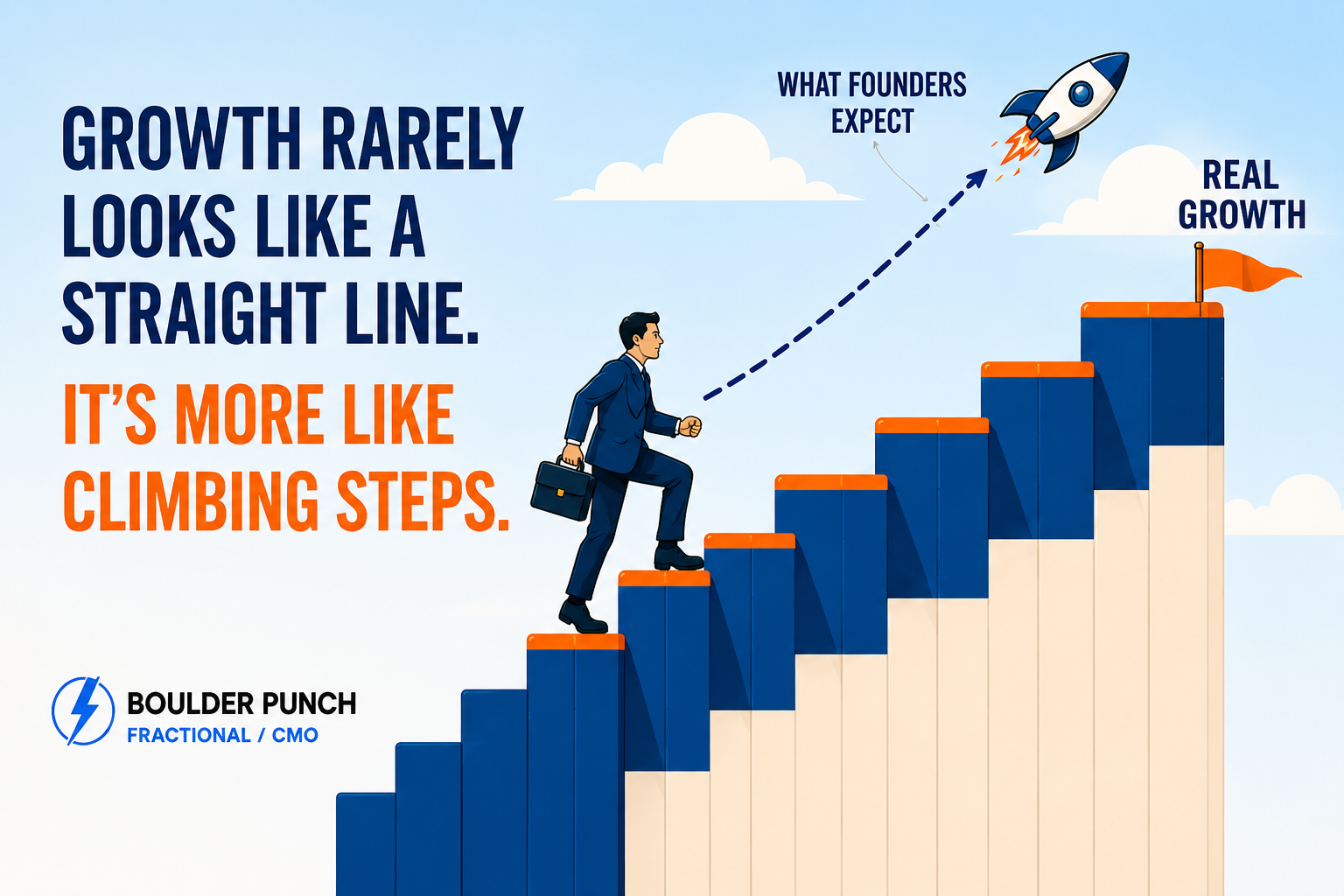
Business Growth Is More Like Climbing Stairs

I've come to think of growth less as a straight line and more like climbing a staircase.

Each level represents a new stage of business maturity.

Every landing provides an opportunity to pause, evaluate, and prepare for what's next.

But reaching the next step requires a different set of muscles.

Different systems.

Different leadership.

Different strategies.

The companies that keep climbing aren't the ones that refuse to change.

They're the ones that recognize when the next level of growth requires a new way of thinking.

The Bottom Line

If your business feels stuck despite strong execution, the problem may not be your marketing, sales team, or budget.

You may simply be facing the next stage of growth.

Sustainable business growth isn't about doing more of what worked yesterday.

It's about recognizing when today's challenges require a different strategy, a different perspective, and a different approach.

Because growth isn't a straight line.

It's a staircase.

And every new level demands a new way to climb.

If your company has reached a growth plateau and you're unsure what comes next, explore our Fractional CMO Services or contact us to discuss your growth challenges and opportunities.

Previous
Previous

Why Business Growth Stalls: The Hidden Cost of Poor Marketing Leadership