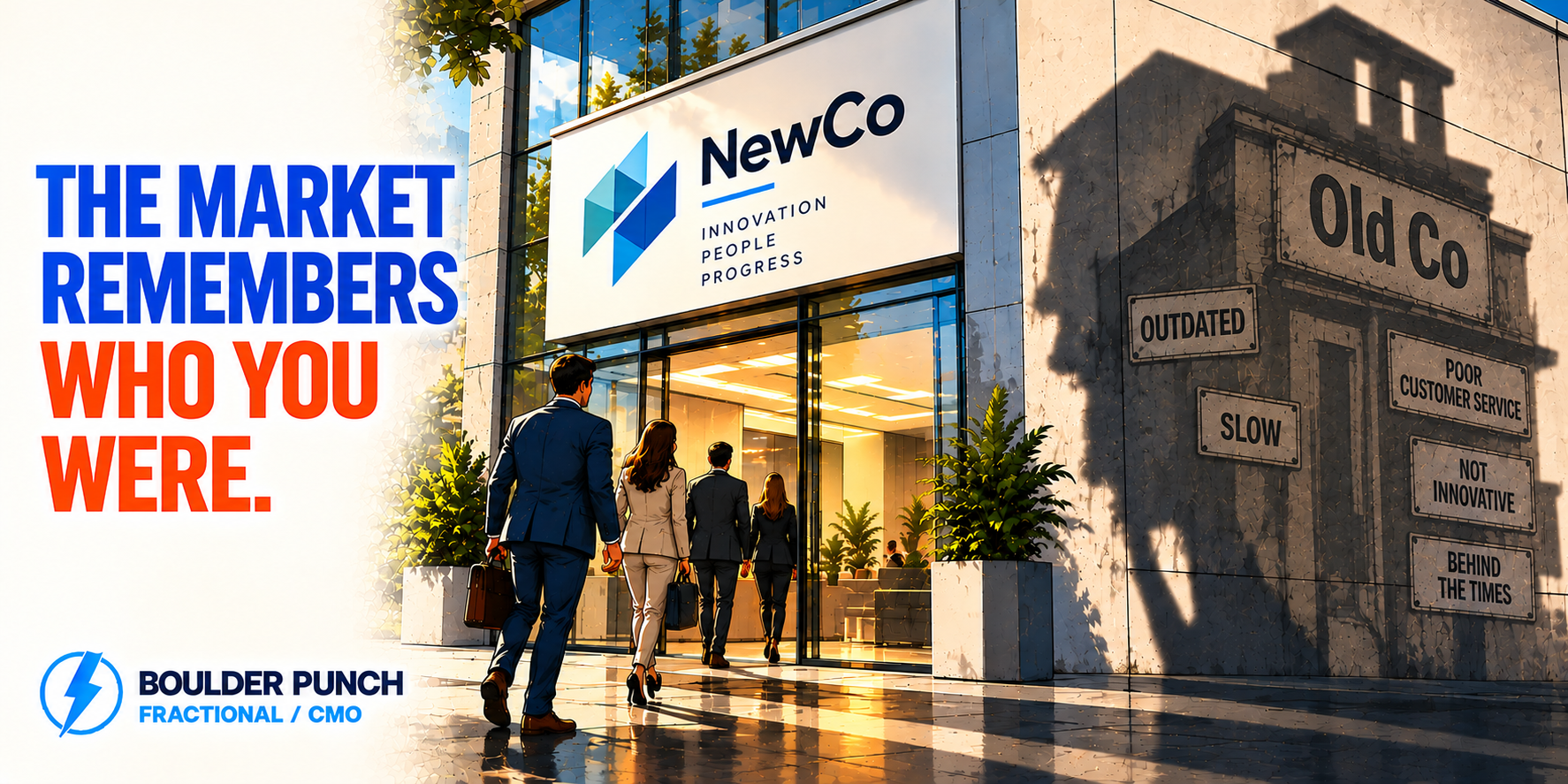
Changing your business is easier than changing what people believe about your business.
Companies change all the time.
They launch new products. Enter new markets. Acquire other businesses. Expand their capabilities. Move from services to software. Add entirely new revenue streams. Sometimes the company that exists today barely resembles the one customers first encountered five or ten years ago.
Internally, that evolution can feel enormous. Leadership has spent months discussing the strategy. Product teams have built new capabilities. Employees have attended meetings and presentations explaining where the company is headed. The website has been updated. New messaging has been developed. Everyone inside the organization feels the change happening in real time.
Then you talk to the market and discover that customers still think you're the company you were three years ago.
I've seen this happen repeatedly, and it's one of the most frustrating challenges in repositioning a business. Companies naturally assume that because they've changed, people's perceptions of them will change at roughly the same speed.
They don't. The market has a long memory.
That's especially true when the original positioning was successful. If customers have known you for years as a consulting firm, they're going to continue thinking of you as a consulting firm even after you've developed a sophisticated software platform. If you built your reputation serving one particular industry, buyers outside of that industry may struggle to see you as relevant to them. If you've always been viewed as a regional company, opening offices across the country doesn't immediately make you a national brand in the minds of customers.
Ironically, the stronger the original reputation, the harder it can be to change.
That's because branding works through association. Over time, customers learn to connect your company with a particular problem, product, experience, or category. That's valuable because familiarity reduces the amount of explaining you need to do. People hear your name and immediately understand where you fit.
Until you decide you want to fit somewhere else.
I've been working recently with companies facing exactly this kind of challenge. Their businesses have evolved substantially, but the market still associates them with the services or capabilities that originally made them successful. The strategic question isn't simply how to introduce something new. It's how to preserve the credibility they've already earned while expanding what customers believe the company can do.
That's a much more complicated assignment than changing a tagline.
One of the mistakes companies make during these transitions is assuming a new identity or messaging platform will reset market perception. They launch a new website, announce the change, update the sales presentation, and expect customers to make the same mental leap leadership has already made internally.
The problem is that customers haven't been sitting in those strategy meetings.
They haven't watched the product evolve. They haven't seen the roadmap. They don't know why leadership made the decision or how much investment went into it. They simply have years of accumulated experience telling them what your company is.
A new message must compete with all that history.
This is why repositioning requires more than communication. It requires evidence.
If a services company wants to become known as a software company, customers need to see the software in action. They need demonstrations, customer stories, product experiences, reviews, industry conversations, and proof that the business genuinely operates differently. If a company wants to move upmarket, the market needs evidence that larger organizations trust it. If a specialist wants to become a platform, buyers need to experience the breadth rather than simply hear the word "platform" repeated in every piece of marketing.
People update perceptions when new experiences become more convincing than old assumptions.
That takes time.
There's also a temptation during repositioning to distance the company from its past. Leadership becomes so excited about the future that the business starts talking as though everything that came before it is obsolete.
I think that's often a mistake.
The old positioning may be exactly where the company's credibility came from. Existing customers trusted the business for a reason. The expertise, relationships, and reputation developed over years don't suddenly lose value because the strategy has changed.
The stronger approach is often evolution rather than reinvention.
If your company spent twenty years developing deep expertise through services and has now turned that knowledge into software, the services heritage isn't baggage. It's evidence that the technology was built by people who understand the problem. If you've dominated one market and are expanding into another, the experience gained in the original market can provide credibility rather than something to hide.
The story becomes less about abandoning who you were and more about explaining how who you were made who you've become possible.
That distinction matters internally too. Employees who built the original business can become skeptical when repositioning makes it sound as though their work belongs to an outdated version of the company. Customers may feel the same way. If the message implies that the products or services they've relied on for years are suddenly less important, the repositioning can unintentionally alienate the people who helped build the business in the first place.
Good repositioning creates a bridge between past and future. It acknowledges what the company has been known for, demonstrates what has changed, and gives the market enough evidence to gradually expand its understanding of the business.
I've found this is also why consistency becomes so important. If Marketing tells the new story while Sales continues telling the old one, the old perception survives. If the website positions the company one way while customer conversations reinforce something different, buyers default to what they already know.
Changing perception requires repetition across the entire organization. The new story has to show up in marketing, sales conversations, product experiences, customer communications, partnerships, thought leadership, and eventually in what customers begin saying about the company themselves.
That's when you know repositioning is starting to work. Not when the new website launches. Not when leadership approves the messaging. Not even when the campaign goes live.
It starts working when customers begin describing the company differently without being prompted.
I've always believed that one of marketing's most important responsibilities is shaping perception, but perception can't simply be declared. It has to be earned through repeated evidence and consistent experience. Companies can change remarkably quickly when leadership commits to a new direction. Markets move at a different speed.
The business may have already become something new. The harder job is helping everyone else see it.