Build the strategy first. Then build the team capable of executing it.
One of the first things I'm usually asked to evaluate when I begin working with a company is the marketing team. Do we have the right people? Should we hire someone? Do we need an agency? Should this role be full-time? Can the existing team handle where we're going?
My answer is usually another question: What are we trying to accomplish?
It sounds obvious, but companies frequently make hiring decisions in the opposite order. Someone decides the business needs a marketing manager, demand generation specialist, content person, social media manager, or agency, and then the organization figures out what that person should be doing. I've always preferred to start with the strategy and work backward.
Once you know where you're trying to go, the capabilities required to get there become much easier to identify.
This becomes especially important as companies grow out of the startup stage. In the early years, roles tend to develop organically because somebody must do the work. The salesperson who understands the website starts managing marketing. An operations person takes responsibility for HubSpot. Someone who's good at writing starts producing content. The founder manages messaging because nobody understands the customer better. Agencies and freelancers get added when specific needs arise.
There's nothing inherently wrong with that. In fact, it's often exactly what an early-stage company needs. People wear multiple hats, decisions happen quickly, and everyone does whatever is necessary to keep the business moving.
The problem comes when the company changes, but the organization around it doesn't.
Marketing becomes more complicated as a business grows. What once required a generalist may eventually require expertise in positioning, demand generation, content, digital advertising, SEO, marketing automation, analytics, customer research, account-based marketing, PR, events, sales enablement, and a growing list of technologies. Very few people are exceptional at all those things, and companies shouldn't expect them to be.
I've met some extraordinarily talented marketing generalists during my career, but even the best generalists have strengths and weaknesses. Someone who is exceptional at brand strategy may not be the right person to manage paid search. A strong demand generation marketer may have little interest in PR. A gifted writer may not be the person you want configuring marketing automation or building attribution models.
That doesn't mean you need fifteen employees. It means you need to understand which capabilities matter most to your strategy.
This is why I resist the idea that there's one correct way to build a marketing department. I've worked with companies where the right answer was a strong internal team. Others needed a small internal team supported by specialized agencies. Some needed freelancers or consultants for narrow areas of expertise. Increasingly, I see companies using a combination of full-time employees, fractional leadership, agencies, independent specialists, and technology.
The org chart matters less than whether the right capabilities exist and whether someone is responsible for bringing them together.
That last part is important because adding specialists can create a different problem. A company may have an SEO agency, PR firm, paid media specialist, freelance designer, internal marketing manager, content writer, and HubSpot consultant, all of whom are talented and doing exactly what they've been hired to do. Yet the overall marketing program can still underperform because nobody is connecting those activities to a common strategy.
I've written about this before because it's becoming one of the defining challenges of modern marketing organizations. Expertise is increasingly easy to buy. Alignment is much harder.
That's why I think team design should begin with strategy rather than job titles. If your primary growth opportunity is expanding within a relatively small group of high-value accounts, you may need account-based marketing, strong sales alignment, personalized content, and marketing operations more than you need a large social media presence. If your challenge is creating consumer demand across local markets, the capability mix will look completely different. If your company is repositioning itself from a service provider to a software platform, brand strategy, customer research, product marketing, content, and sales enablement may become more important than simply generating more leads.
The strategy tells you what capabilities matter. Only then should you decide how to acquire them.
There's another part of this conversation that can be uncomfortable. Sometimes the people who helped a company reach one stage of growth aren't the people best equipped to take it through the next one. That doesn't mean they failed.
Someone may have been exactly what the company needed when marketing consisted of managing the website, supporting Sales, organizing trade shows, and producing collateral. As the business grows, the role may require strategic planning, analytics, team leadership, budgeting, technology management, customer research, and executive-level collaboration. That's a fundamentally different job.
Strong leaders recognize this without dismissing the contributions people made along the way. Sometimes existing employees can grow into the new role with mentoring, training, and support. Sometimes responsibilities need to change so people can focus on what they do best. And sometimes the organization needs expertise that simply doesn't exist internally.
I've found the best team-building decisions happen when leaders stop asking whether a particular person is "good" and start asking whether the person's skills match what the strategy now requires. Those are very different questions.
The same applies to agencies and outside partners. Companies sometimes maintain relationships long after their needs have changed because the agency has become familiar and comfortable. The agency may still be doing perfectly good work, but if the company's strategy has evolved, the expertise it needs may have evolved too.
None of this is about constantly rebuilding the team or chasing the latest marketing specialty. Stability matters. Institutional knowledge matters. Relationships matter. But organizations need to evolve alongside the businesses they're supporting.
I've developed plenty of marketing strategies throughout my career, and I've learned that the presentation is the easy part. You can develop brilliant positioning, identify the right customers, choose the right channels, establish KPIs, and create a detailed roadmap. It can all make perfect sense in the conference room.
Then Monday morning arrives. Someone must own it. Someone must execute it. Someone must make decisions when priorities conflict, coordinate internal teams and outside partners, evaluate results, and keep the strategy moving after the initial enthusiasm fades.
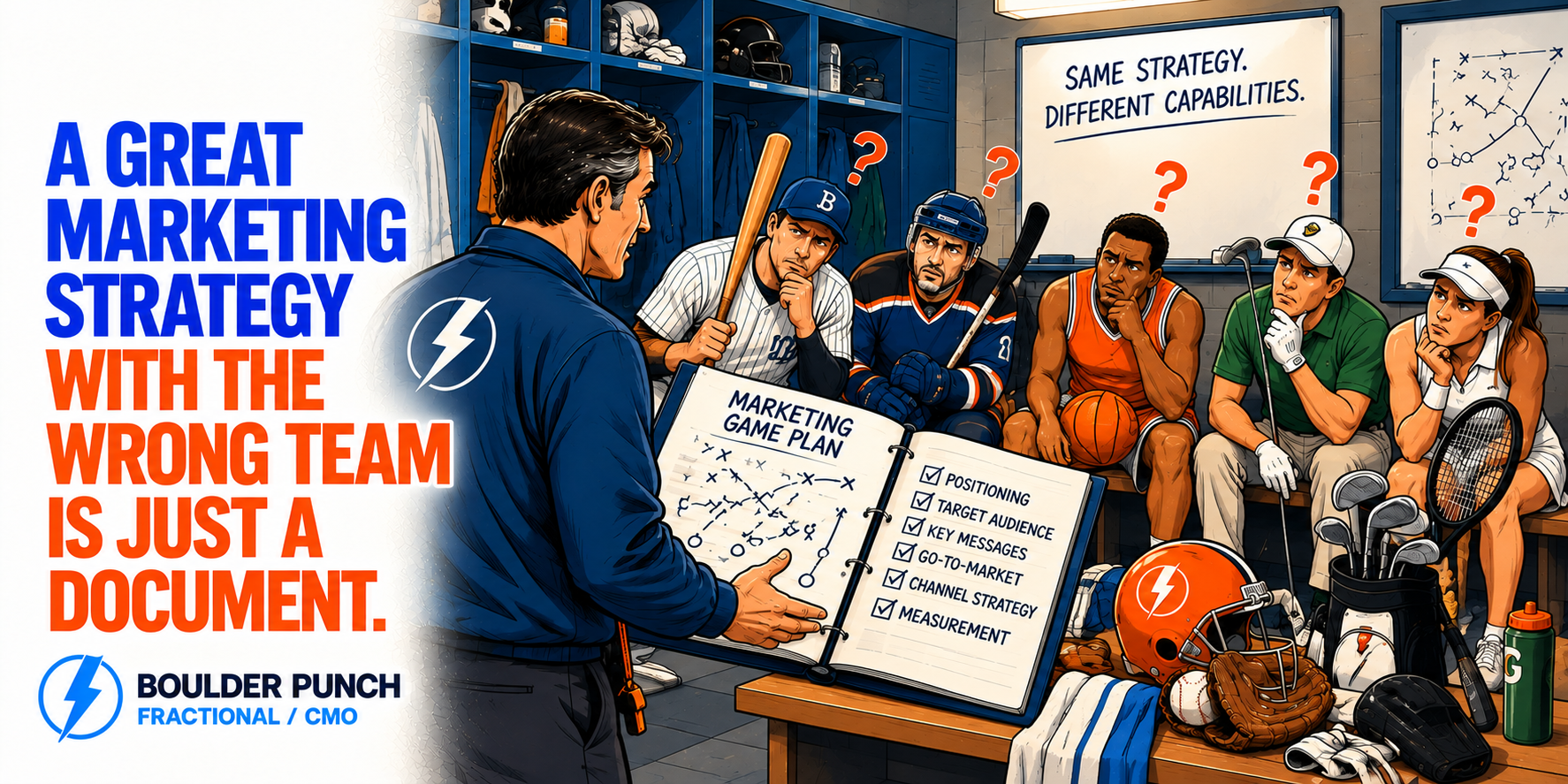
Without those people, the strategy isn't really a strategy; it's a document.
The strongest marketing organizations I've worked with aren't necessarily the largest or the most expensive. They're the ones where the capabilities, responsibilities, and resources match what the business is trying to accomplish. Everyone understands the strategy, knows what they own, and has the expertise and authority to execute it.
Start with where the business needs to go. Determine what marketing must do to help it get there. Then build the team around that reality.
Not the other way around.