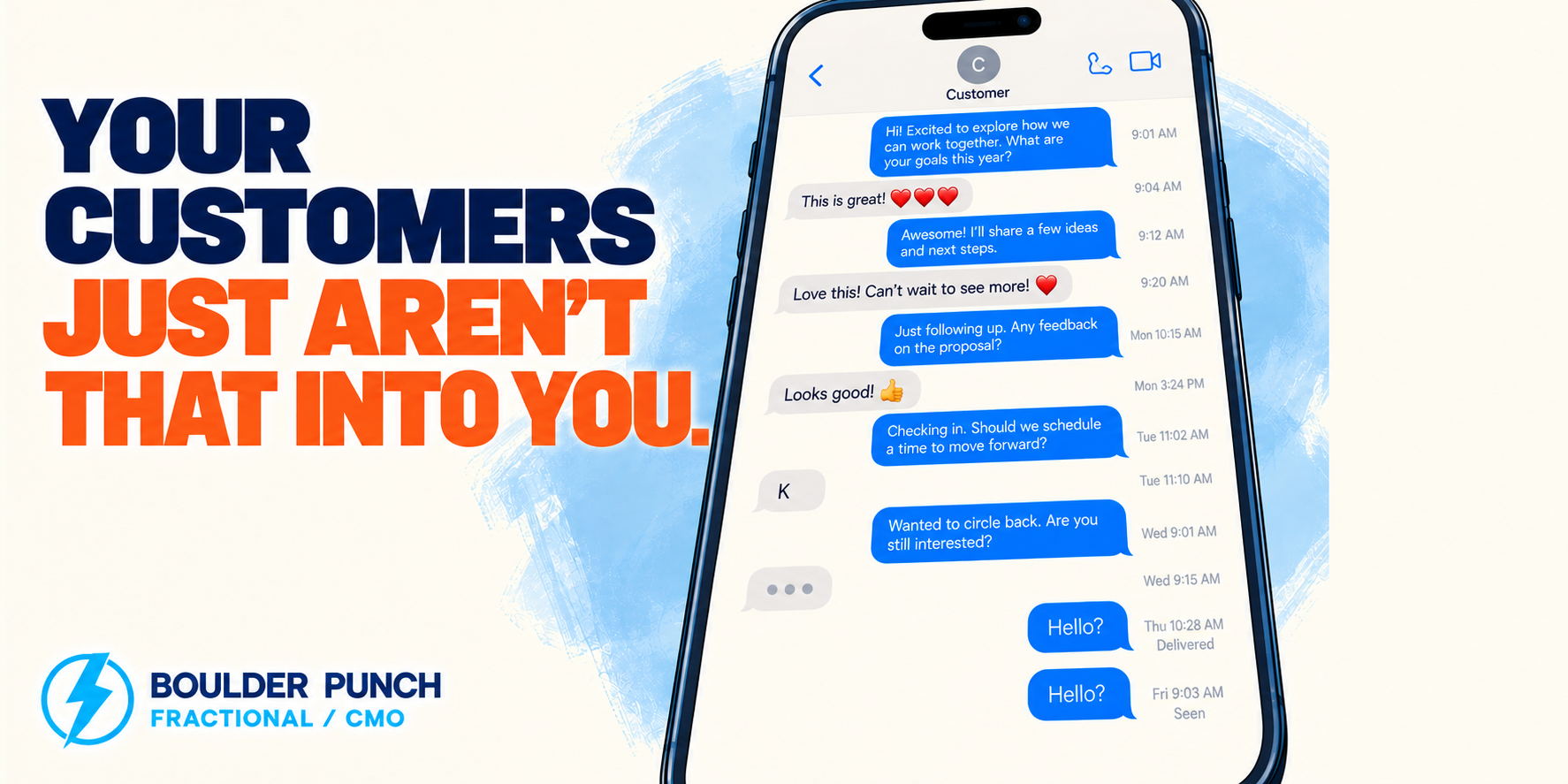
Customer loyalty is a relationship, not a lifetime commitment.
We need to talk.
I know things seemed great in the beginning. You called all the time. You listened. You remembered what mattered to me. You sent helpful information and seemed genuinely interested in my problems. You introduced me to people who could help and checked in just to see how things were going.
You really made an effort.
Then I became a customer, and things changed. The thoughtful conversations became automated emails, most of them trying to sell me something else. You stopped asking what I needed and started telling me about your new products. When I had a problem, I met your support ticketing system. And now, every February, you send me an email telling me how much you love your customers.
It’s not me. It might be you.
Companies spend an extraordinary amount of energy courting customers. Marketing studies them. Sales pursues them. We personalize communications, nurture relationships, answer questions, schedule demos and build proposals. We remember every interaction in the CRM. A promising prospect can have half the company asking what it will take to get the relationship across the finish line.
Then they sign the contract, and the courtship is over.
Obviously, good companies don’t intentionally stop caring about customers after the sale. But organizational behavior can make it feel that way. Marketing goes back to finding the next prospect. Sales focuses on the next deal. Customer service handles problems. Account management handles renewals. Finance sends invoices. The customer who once had everyone's attention gradually becomes somebody else's responsibility.
That’s a dangerous way to think about a relationship you hope will last for years because customer loyalty isn’t a lifetime commitment. Your customers don’t owe you another year because they bought from you last year. They don’t owe you the next purchase because you won the first one, and they don’t have to overlook a deteriorating experience because your companies have been together for a long time. Loyalty has to keep being earned.
I think companies sometimes forget this because retention can feel passive compared with acquisition. Winning a new customer is visible. There’s a lead, an opportunity, a proposal and eventually a closed deal. Everyone can celebrate. A customer who quietly renews for the fifth year doesn’t create quite the same excitement, even though that customer may be far more valuable.
They already understand your product. They know your people. You don’t have to introduce the brand from scratch. If they trust you, they may buy additional products, expand the relationship, introduce you to colleagues or recommend you to others. That kind of relationship can become one of the strongest growth assets a company has, right up until you start taking it for granted.
This is where the dating analogy becomes uncomfortably accurate. Relationships rarely collapse because someone forgot to send enough promotional emails. They deteriorate because people stop paying attention.
The same thing happens with customers. When was the last time you asked what had changed in their business or gave them something useful without asking for anything in return? Do they hear from you throughout the year, or primarily when renewal is approaching? Do your longest-standing customers receive the same attention as the shiny new logo your sales team just landed? Does anybody inside the company still understand why they chose you in the first place?
Those questions matter because customers change. The problem they originally hired you to solve may have evolved. New people may be making decisions. Their business may have grown. Their priorities may have shifted. A competitor may now offer something that didn’t exist when the relationship began. And while you’ve been assuming everything is fine, someone else may have started courting them.
They’re listening, asking questions and paying attention. They may even remember their birthday.
This doesn’t mean customer retention should become an endless parade of grand romantic gestures. You don’t need to send roses with every renewal agreement. Usually, the important things are much less dramatic: listen, communicate, keep your promises, solve problems when they occur, and help customers get more value from what they already bought.
Teach them something useful. Recognize when their needs have changed. Occasionally do something thoughtful when there isn’t an invoice attached. Most importantly, make sure the experience they receive after becoming a customer lives up to the one you promised while trying to win them.
Marketing and Sales spend a lot of time making promises about what a relationship with the company will be like. The brand gets defined through websites, presentations, demos, advertising and sales conversations. Then the customer gets to find out whether any of it was true.
That experience becomes the real retention campaign.
No clever email sequence can compensate indefinitely for a disappointing product. No loyalty program can overcome bad service. And no Valentine’s Day message about how much you appreciate your customers matters very much if they spent the previous eleven months feeling ignored.
The encouraging part is that you already did the hardest work. You got them to say yes. They chose you. Now give them reasons to keep choosing you.
So, this Valentine’s Day, by all means, tell your customers you love them. Send the email. Mail the card. Hand out the chocolate.
Just remember that the same rule applies in business that applies everywhere else: if you really care about the relationship, February 14th probably shouldn’t be the only day they can tell.